
Engineering application guide
Composite PV Ribbon for Copper-Saving Modules
To compare copper use in a PV module, start with its approved ribbon and cell layout. Evaluate copper-aluminum composite ribbon against the required resistance, complete geometry, coating and module bill of materials.
Discuss the assembly requirementsOn this page
Composite conductor in the module
- 1Cell contact
- 2Composite interconnect
- 3String busbar and module connection
Copper and aluminum define the base conductor; the outer solder coating performs the joining role. Compare each ribbon position against the approved reference.
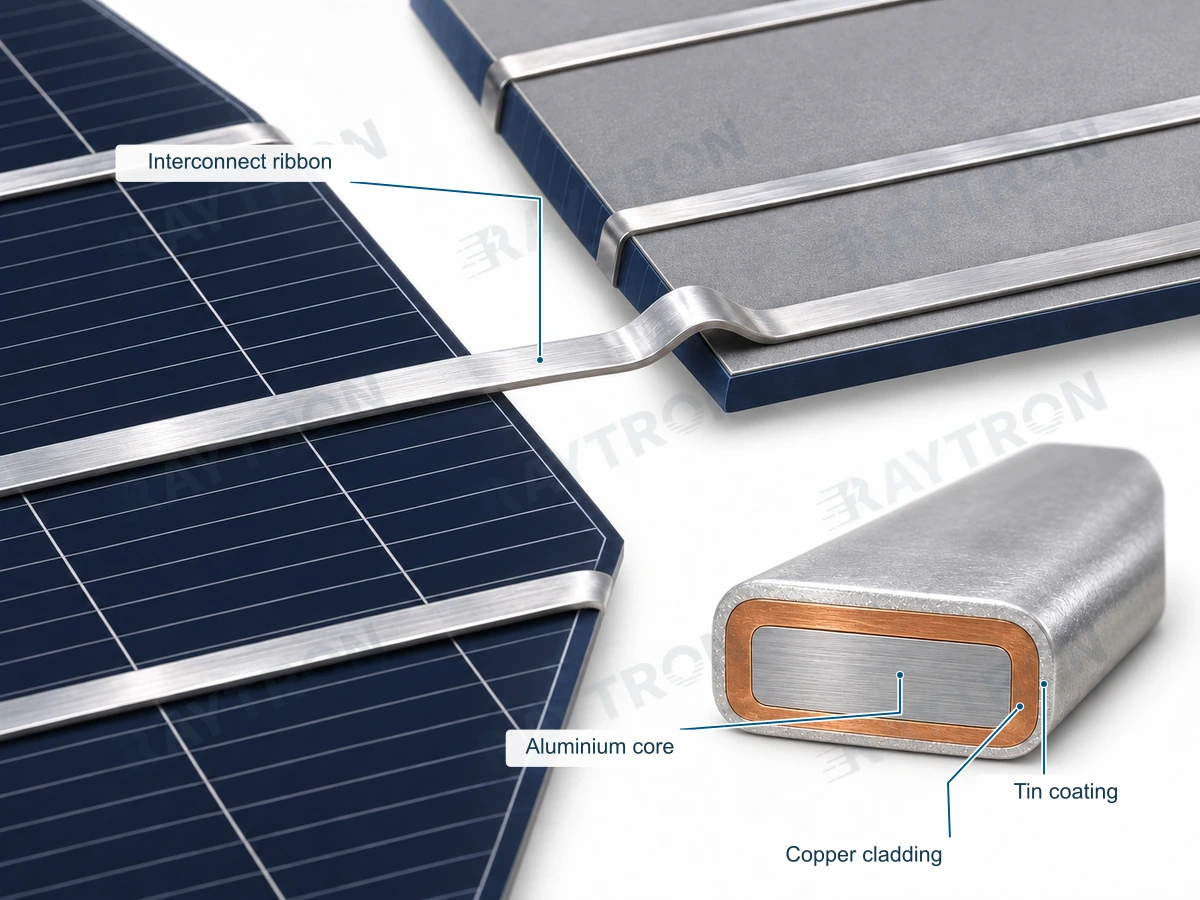
A ribbon saving is a reduction in procurement cost of the ribbon being replaced. It is not the same percentage reduction in total module manufacturing cost.
Related conductor products
Design and testing
- Construction and comparison
- Specify core and cladding, ratio basis, ribbon section, coating and reference copper ribbon; compare at the required resistance and module layout.
- Cell and joining process
- Identify cell metallization, stringer settings and peel-test method. Check forming, coating adhesion and joints at cut or formed areas.
- Module acceptance
- Agree resistance, EL inspection and module reliability tests for the exact materials and process. Use the specified sample construction and process for module qualification.
Application design factors
Compare copper and composite ribbon using the same module current path, cell layout and electrical performance requirements.
Application design record — open worksheet
Record your project requirements and observations, then download or include them in an inquiry.
| Item | Information / units | Your input |
|---|---|---|
| Common output | Same module current path, cell layout, ribbon length and accepted module output | |
| Material and process | Actual bare/finished geometry, layer basis, mass, coating, stringer settings and yield | |
| Evaluation | Resistance, joint/EL/reliability methods and sample records; cost quotation date/currency and changed processing |
Other formats and preview
Save or restore a draft
Drafts stay in this browser. Clear inputs also removes the saved draft.
Worksheet version: RT-RFQ-WORKSHEET-1.
How should copper use be compared between ribbon designs?
Compare conductor mass and copper content at the required resistance, current path and module layout. Include coating, process yield, joining performance and module test results in the material decision.