
Composite and Copper PV Ribbon: Plan a Side-by-Side Trial
Use the current copper ribbon as the baseline. Compare conductor structure, resistance, coating and dimensions, then run both materials through the specified stringing process. Record joint quality, cell stress, module results and material use under the same trial conditions.
Read a trial from the baseline through to the module
Follow current ribbon → candidate dimensions → stringing trial → module comparison. Fix the current path, output basis and test conditions while identifying each changed construction or process input.
Use line feeding and joint results to decide whether the candidate can enter the next module test. Keep the measured observation, applicable limit and sample identity together; a good-looking joint alone is not a release result.
Full ribbon procurement and trial guideEngineering comparison
Scroll horizontally to view all columns.
| Decision | Copper-Aluminum Composite PV Ribbon | Conventional Copper PV Ribbon | Comparison conditions |
|---|---|---|---|
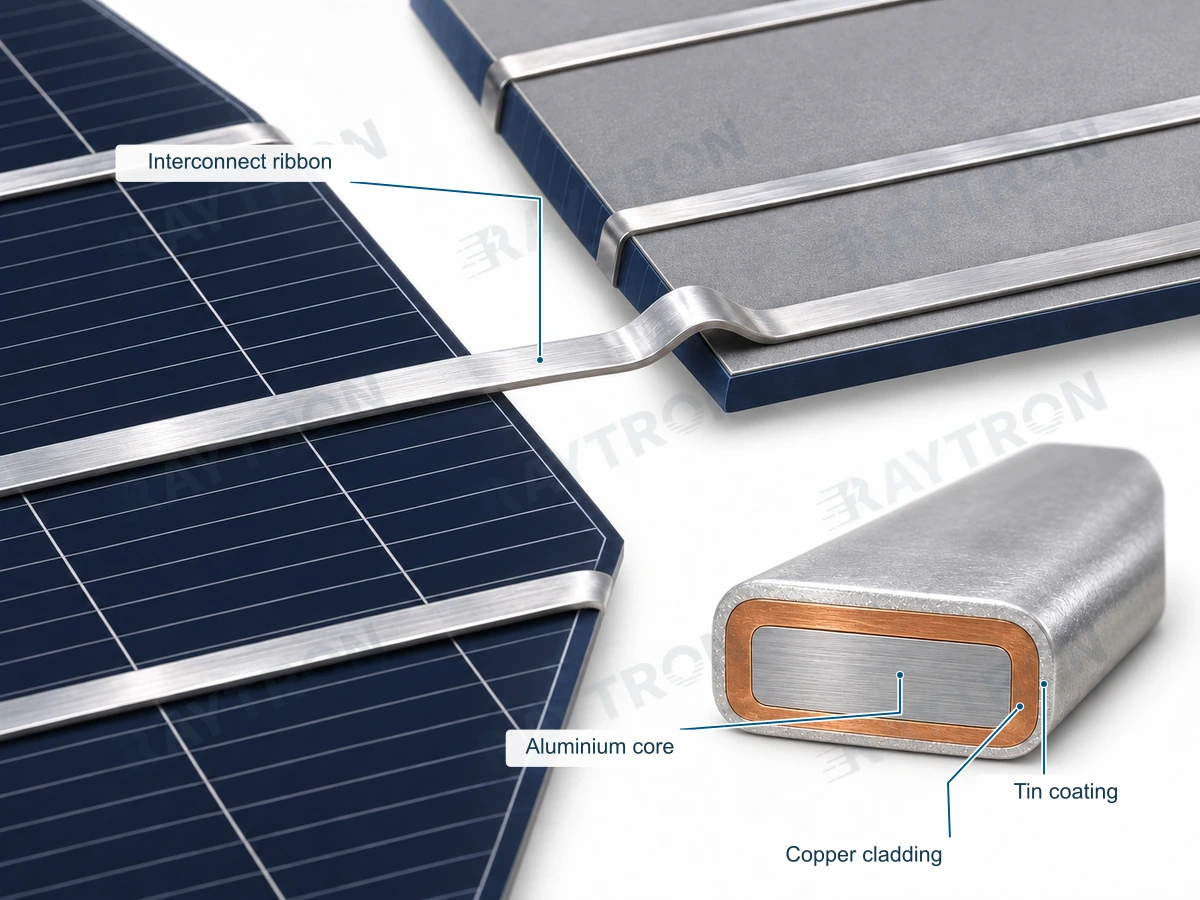
| Conductor | Copper-aluminum layered conductor with defined solder coating | Copper-base conductor with defined solder coating | Record layer structure separately from the solder finish. |
| Trial design | Candidate section and required material quantity | Current production ribbon section and quantity | Hold required resistance, module layout and trial conditions constant. |
| Process and results | Record joining, cell stress, EL/module results and yield | Record the same joining, cell stress, module results and yield | Use side-by-side results; conductor mass alone does not establish a module gain. |
PV baseline / candidate sample trial — open worksheet
Record your project requirements and observations, then download or include them in an inquiry.
| Item | Information / units | Your input |
|---|---|---|
| Baseline and candidate | Product/drawing revisions, layer/coating construction and actual bare/finished geometry | |
| Fixed conditions / variables | Cell/module layout and current path, test environment, output basis, equipment; identify every changed input | |
| Specimens and ownership | Material/cell/process lots, sampling plan, sample count and decision owner; agree before trial | |
| Limits and methods | Requirement source/revision, resistance/temperature/joint/EL or reliability methods and units; no universal pass value | |
| Results and disposition | Measured characteristic, specimen, test conditions, acceptance criterion and final disposition |
Other formats and preview
Save or restore a draft
Drafts stay in this browser. Clear inputs also removes the saved draft.
Worksheet version: RT-RFQ-WORKSHEET-1.
Composite and Copper PV Ribbon: Plan a Side-by-Side Trial: comparison record — open worksheet
Record your project requirements and observations, then download or include them in an inquiry.
| Item | Information / units | Your input |
|---|---|---|
| Comparison basis | Choose a common basis; no automatic equivalence is inferred | |
| Baseline and candidate | Materials, construction, form and drawing revisions | |
| Conductor | Copper-aluminum layered conductor with defined solder coating | Copper-base conductor with defined solder coating · Record layer structure separately from the solder finish. | |
| Trial design | Candidate section and required material quantity | Current production ribbon section and quantity · Hold required resistance, module layout and trial conditions constant. | |
| Process and results | Record joining, cell stress, EL/module results and yield | Record the same joining, cell stress, module results and yield · Use side-by-side results; conductor mass alone does not establish a module gain. | |
| Methods, conditions and evidence | Units, test conditions, result source and reviewer |
Other formats and preview
Save or restore a draft
Drafts stay in this browser. Clear inputs also removes the saved draft.
Worksheet version: RT-RFQ-WORKSHEET-1.
Products and specifications
Include the drawing, intended application and acceptance criteria when requesting a comparison.
Plan a ribbon comparison trial