
1. Utility specifications provide concrete application routes
CCA appears in specific utility technical documents. ENEL, EPM and Eskom references identify routes for concentric neutrals, service cables and alloy-core trials respectively.1, 2, 4
| Application route | Published reference | Value to the cable manufacturer |
|---|---|---|
| ENEL Italian LV concentric cables | GSCC014 Rev.00, Amendment 01/2025, includes CCA concentric neutrals in Types I–III | Start from the specified neutral position, cross section and resistance |
| Grupo EPM 600 V service-cable reference | ET-TD-ME01-18 Rev.2, 2018, describes CCA phase and concentric-neutral conductors | Provides material and construction detail; use the buyer's controlled issue for new work, with the CENS directory marking this entry under update |
| Eskom LV service/control-cable trials | 240-56063805 Rev.3, 2022, §3.2.1(c), includes a route for new conductor types such as CCAA | Define the alloy core, supplied condition and project evaluation together |
These references establish industry technical routes. The applicable issue, complete cable construction and supplier qualification are confirmed for each project.1, 2, 3, 4
A concentric neutral creates a clearly defined replacement scope
Concentric neutral wires surround the insulated core or cores. A cable manufacturer can retain its phase-conductor concept and focus the comparison on copper versus CCA outer wires: total area, count, diameter, lay, connections and purchasing cost.
The layer performs its assigned neutral duty, including the relevant imbalance, harmonics and protection requirements. Its physical position and its electrical duty are considered together.10
A phase-conductor option follows the phase requirements
For CCA phases in service cables, design resistance, core dimensions, current rating, voltage drop and terminals together. The cited EPM specification provides a construction reference. Identify N, PE and PEN functions on the project drawing and evaluate each against its assigned electrical and connection requirements.2
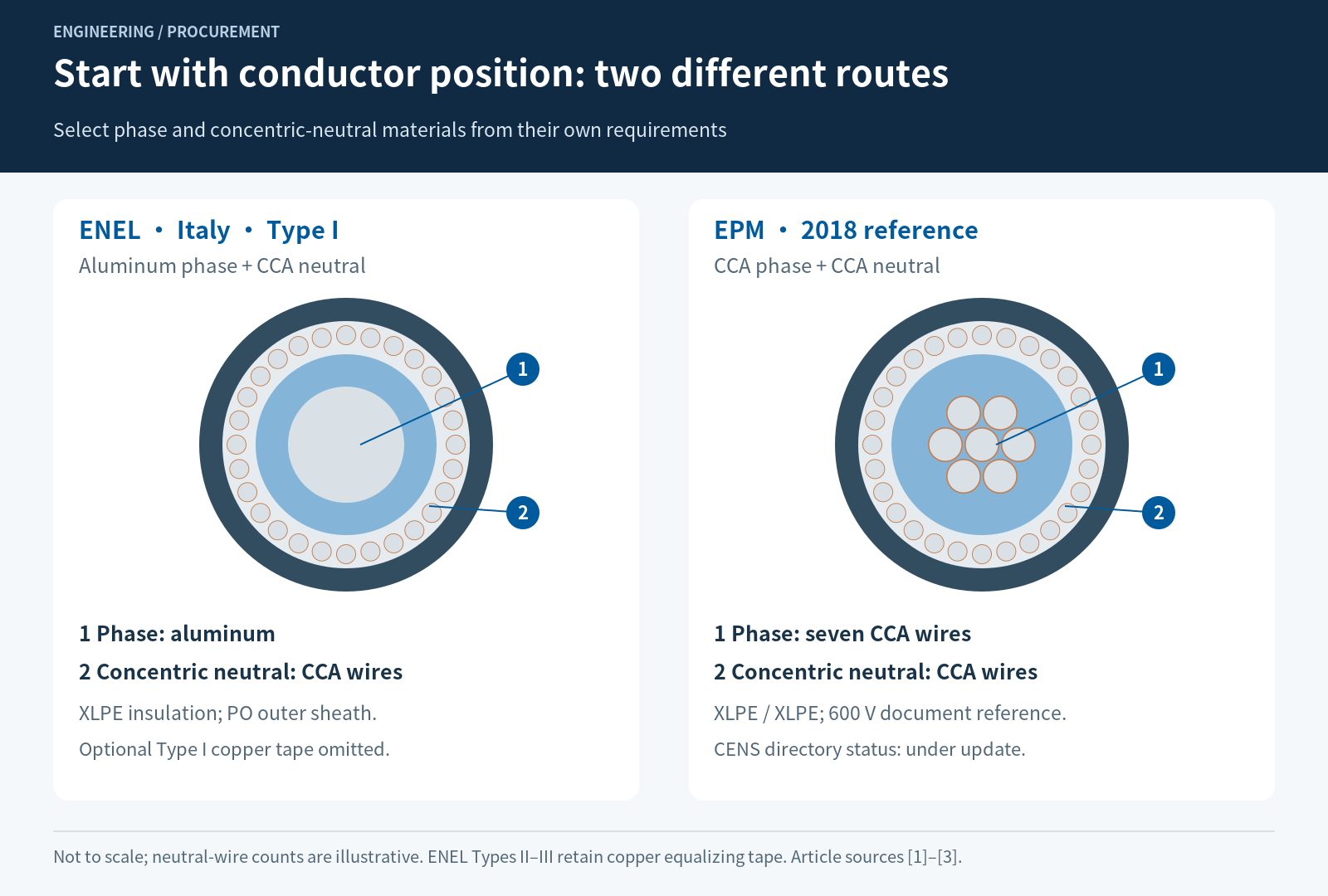
Schematic; wire counts and dimensions are illustrative. The Type I view omits optional equalizing tape. Types II and III retain the copper tape specified by ENEL.1
2. Translate finished-cable resistance into a purchasable wire specification
The useful target is resistance after the conductor has been built into the cable. RAYTRON's selection work starts there and connects material resistivity, actual metal area, individual-wire dimensions and lay length.
| Design step | Define | Purchasing and production value |
|---|---|---|
| Set the resistance target | Maximum Ω/km at 20°C and project requirements | A clear electrical objective |
| Select material and wires | Core, copper fraction, diameter, count and total actual area | A candidate wire arrangement that can be quoted |
| Include the real path | Layer pitches, wire consumption and process allowance | Consistent resistance and mass calculations |
| Match the supply condition | Mechanical properties, spool format, joint agreement and batch data | Inputs suited to payout and stranding |
Lay length affects both resistance and purchasing
A cable length of 1,000 m uses more than 1,000 m of each helically laid wire. The model's k = 1.02 means approximately 1,020 m of wire per cable kilometre.
That additional 2% belongs in both the resistance calculation and the purchasing weight. The engineering and procurement comparisons must use the same structural input.
For parallel wires of the same material and common path-length factor:
Actual area A = n × π × d² / 4
Resistivity at 20°C, ρ20 = 1.7241 / c
Finished-conductor resistance R20 = 1000 × ρ20 × k / A
Conductor mass M = A × k × density
Use mm² for A, mm for individual diameter d, and wire count n. Enter c as the IACS percentage number, such as 64.416. R20 is Ω per cable kilometre and M is kg per cable kilometre. k is wire length divided by cable axial length. Calculate different layers using their respective paths, conductances and consumption.
Turn a 1.15 Ω/km requirement into a material discussion
The ENEL amendment includes a 16 mm² copper/22 mm² CCA entry with a maximum 20°C resistance of 1.15 Ω/km.1
Assume 22 mm² actual CCA area, k = 1.02, and only the wires, with no parallel contribution assigned to the equalizing tape. The reference conductivity requirement calculates as:
c = 1724.1 × 1.02 / (22 × 1.15) ≈ 69.5% IACS
The inquiry changes from “22 mm² CCA” to a defined resistivity requirement for the intended construction. The 69.5% value is a screening result under these assumptions; selection also addresses the permitted actual construction and resistance margin. The 25 mm² purchasing example below is a separate model, not a revision to that specified 22 mm² entry.
This is the value of discussing the design with RAYTRON: select copper fraction, wire size and mechanical condition together under the resistance target, giving the cost comparison a clear electrical basis.
3. What does the purchasing comparison show at closely matched resistance?
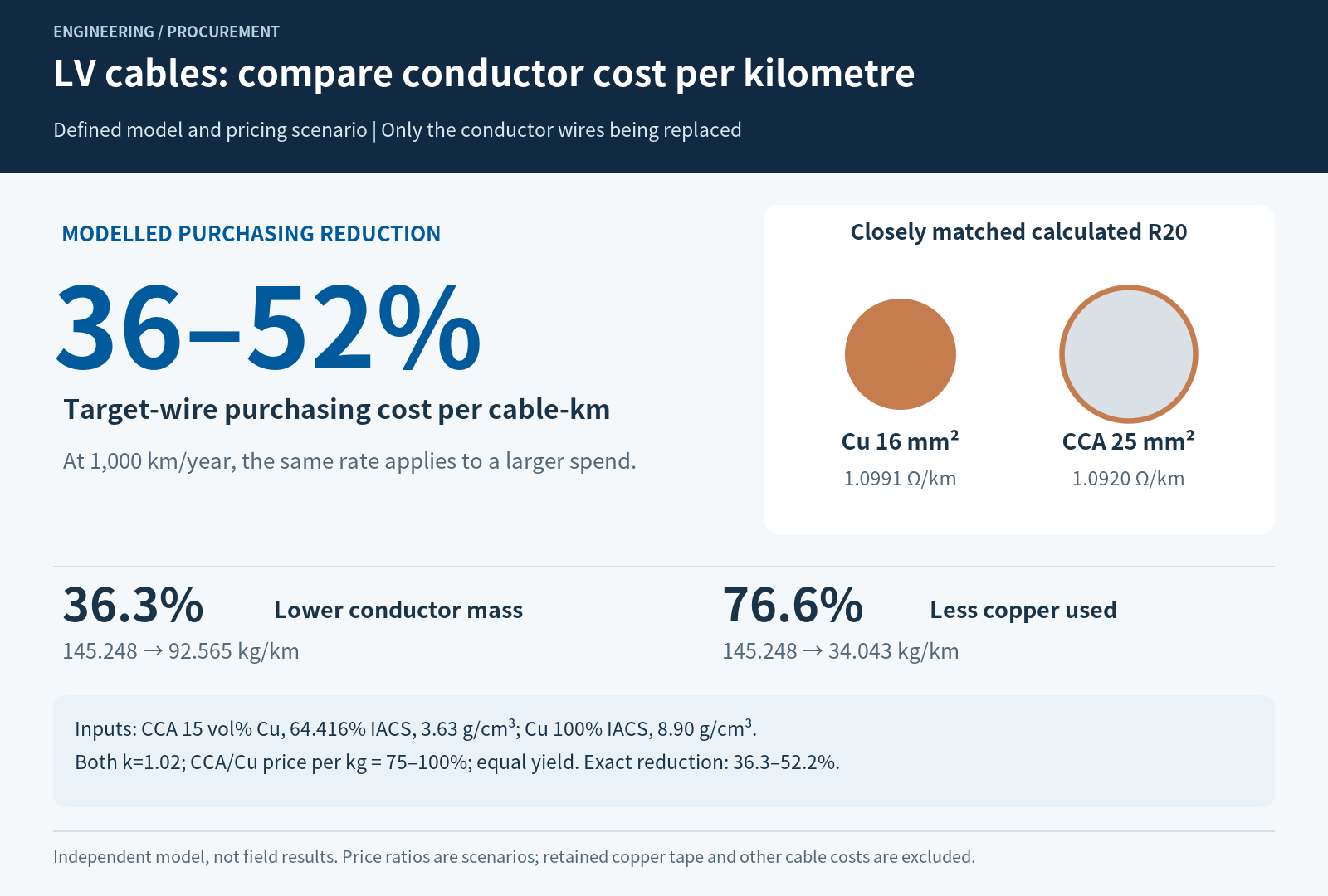
| One target conductor group per cable kilometre | Copper | Reference CCA |
|---|---|---|
| Actual total metal area | 16 mm² | 25 mm² |
| Conductivity at 20°C | 100% IACS | 64.416% IACS |
| Copper volume fraction | 100% | 15% |
| Density | 8.90 g/cm³ | 3.63 g/cm³ |
| Lay-length factor | 1.02 | 1.02 |
| Calculated R20 | 1.0991 Ω/km | 1.0920 Ω/km |
| Conductor metal mass | 145.248 kg/km | 92.565 kg/km |
| Copper contained | 145.248 kg/km | 34.043 kg/km |
This comparison aligns 20°C DC resistance. Operating temperature, current rating, fault duty and connection performance enter the complete cable design and trials. CCA properties are published reference inputs; delivered material uses the agreed specification.5, 8
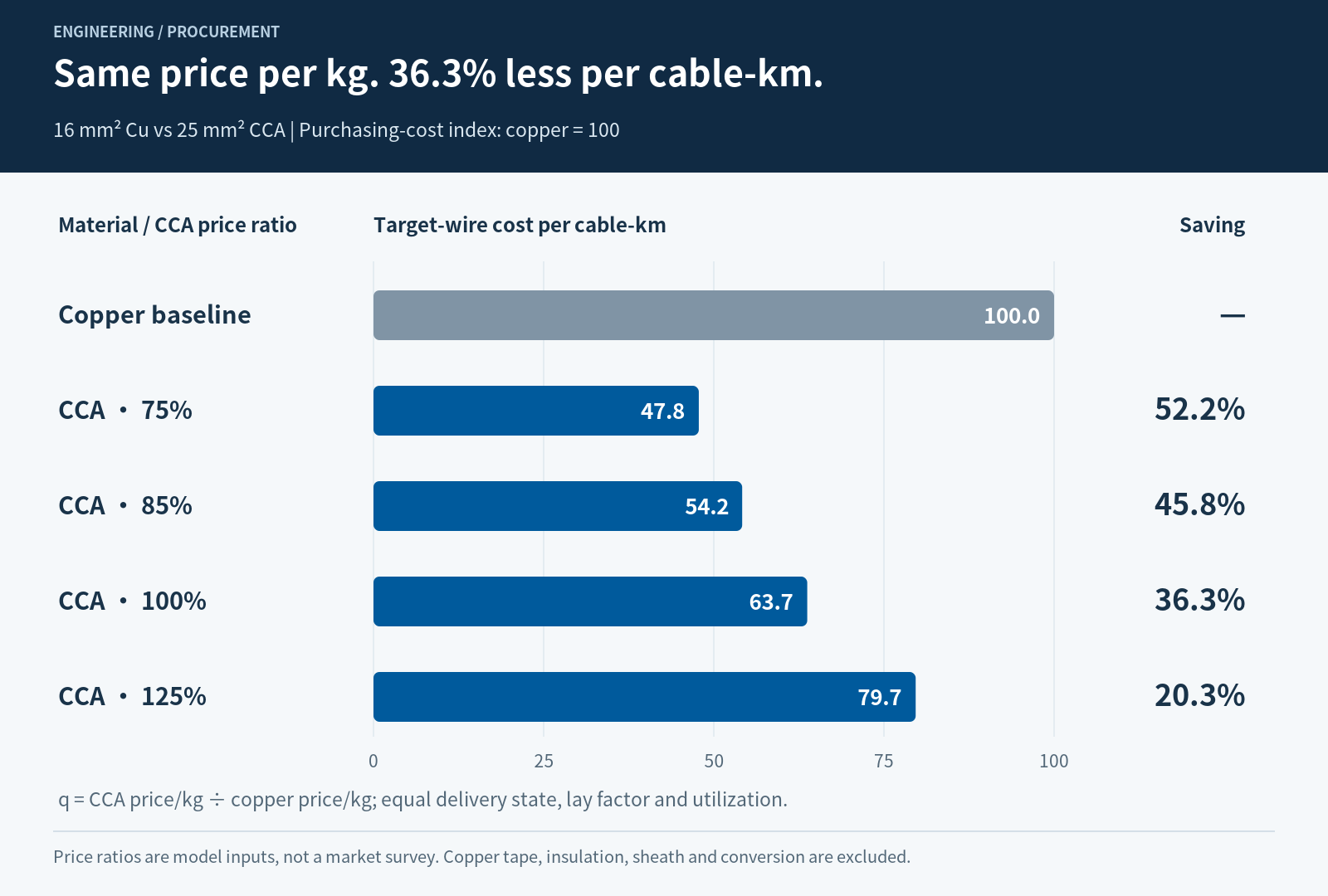
Equal prices per kilogram still give a 36.3% wire-cost reduction per kilometre
Wire purchasing cost per cable-km = mass per cable-km × delivered bare-wire price/kg
q = CCA price/kg / copper bare-wire price/kg
Purchasing reduction in this example = 1 − 0.6372893 × q
| CCA price/kg relative to copper | Copper cost index | CCA cost index | Target-wire purchasing reduction |
|---|---|---|---|
| 75% | 100 | 47.8 | 52.2% |
| 85% | 100 | 54.2 | 45.8% |
| 100% | 100 | 63.7 | 36.3% |
| 125% | 100 | 79.7 | 20.3% |
The larger cross section has already been included, and the CCA conductor is still lighter per kilometre. That is the advantage a price-per-kilogram comparison misses.
Carry the per-kilometre advantage into the annual budget
For 1,000 km of identical cable annually, each containing one compared conductor group, metal purchases fall from 145.248 to 92.565 tonnes. Copper content falls from 145.248 to 34.043 tonnes. At the 85% price ratio, purchasing spend on that conductor group falls by 45.8%.
Build the annual calculation from actual cable lengths and conductor quantities, weighted by baseline expenditure. Cost retained copper tape separately. Material utilization and changes in insulation or sheath belong in the complete-cable budget. A clear conductor comparison shows how much purchasing room the material change can create for the finished product.
4. Six properties to fix in a RAYTRON wire specification
Useful LV material support connects cladding, drawing, annealing and supplied condition. RAYTRON works across these material-process requirements to translate cable objectives into a wire specification.11
| Control | Specification content | Value to the customer |
|---|---|---|
| Core and condition | Aluminum/aluminum alloy, agreed grade and temper | Align resistance, strength and downstream processing |
| Cladding distribution | Volume fraction, local minimum thickness, eccentricity and continuity | Inspect overall composition and local quality together |
| Electrical properties | Maximum 20°C resistivity or resistance over a defined length | Feed incoming-wire values into the cable resistance budget |
| Wire geometry | Diameter, tolerance and roundness | Control metal area, arrangement and mass per kilometre |
| Mechanical and bond performance | Strength, elongation, gauge length and bend/twist evaluation | Match payout, stranding, bending and joining |
| Delivery and traceability | Spool, winding, net mass, joint agreement and batch identity | Maintain consistent inputs from trials to repeat orders |
Select aluminum-core CCA or alloy-core CCAA for the project. RAYTRON's HTCCA name is resolved into specific core, copper fraction, resistance and mechanical-condition requirements in the order. Defined acceptance limits, processing condition and delivery format make a specification usable for purchasing.
ASTM B566 can support relevant bare-round-CCA checks. Finished-cable evaluation follows the specified product standard and project documents, including the material scope and applicability of IEC 60228 where relevant.6, 7
5. Three steps from trial wire to a purchasing decision
| Stage | Work with the cable manufacturer | Decision |
|---|---|---|
| Design comparison | Copper and CCA resistance, area, mass and comparable quotations | Which candidate offers a worthwhile purchasing opportunity? |
| Cable-line trial | Actual count, diameter, lay, processed cladding, R20 and material utilization | How should the material enter the existing process? |
| Connection and finished-product confirmation | Defined terminals, tools and process; project-specific thermal, mechanical and other tests | Which complete construction moves into purchasing? |
Select the CCA grade, size, conductor construction, connector and process settings as a combination. Record initial connection resistance, mechanical retention and the project's thermal/fault-duty results. The cable manufacturer handles stranding, any required compaction, insulation and finished-cable manufacture; RAYTRON supplies bare wire and material support.9
Return the confirmed construction, material and delivery condition to the purchase specification so the trial result becomes a repeatable supply requirement.
Frequently asked questions
Which LV cables are worth discussing first?
Start with concentric-neutral and service-cable projects that have a defined material route. An existing drawing and buyer specification establish the conductor position, after which resistance, wire arrangement and purchasing cost can be compared.1, 2
What does the 36–52% saving include?
Purchasing the wires replaced in the 16 mm² copper/25 mm² reference-CCA scenario, at price ratios of 75–100%. A project uses its own construction, material properties, quotation and utilization.
Does CCA require a larger area?
Size it from the resistance target. This model increases area from 16 mm² copper to 25 mm² CCA, changes calculated R20 from 1.0991 to 1.0920 Ω/km, and reduces metal mass per kilometre by 36.3%. Complete selection then accounts for the permitted construction and finished-product requirements.
What happens to copper equalizing tape?
Retain and cost it according to the cable specification. For example, the cited ENEL Type II and III constructions require copper equalizing tape. This guide's purchasing reduction applies to replaced wires only.1
Can the current connector be retained?
Provide its model together with the conductor construction. Determine the combination from material suitability, dimensions, tools and process requirements, then confirm it through the project's connection evaluation.
What is needed for the first inquiry?
Send a cable cross section, target market or buyer specification, and the conductor position to be replaced. Include the resistance limit, wire size/count and volume already available. Complete the remaining inputs during the discussion.
Turn your copper baseline into a comparable CCA option
Start with one drawing. Discuss three outputs with RAYTRON: candidate wire specifications, purchasing cost per kilometre and priorities for a line trial.
Compare my LV cable conductor with RAYTRON · Explore LV concentric-neutral wire · Review utility specifications
RAYTRON — Engineering Every Micron.
Sources and calculation basis
Mass, resistance, copper consumption and purchasing percentages are calculated from the stated inputs. Public documents use the editions identified above. Reference properties support the calculations; supply limits belong in the agreed specification.
Utility references: ENEL, EPM, CENS directory and Eskom.
Materials and standards: Reference CCA properties, ASTM B566, IEC 60228, IEC 60287-1-1 and IEC 60502-1.
Technical information: Neutral sizing and RAYTRON manufacturing technology.