
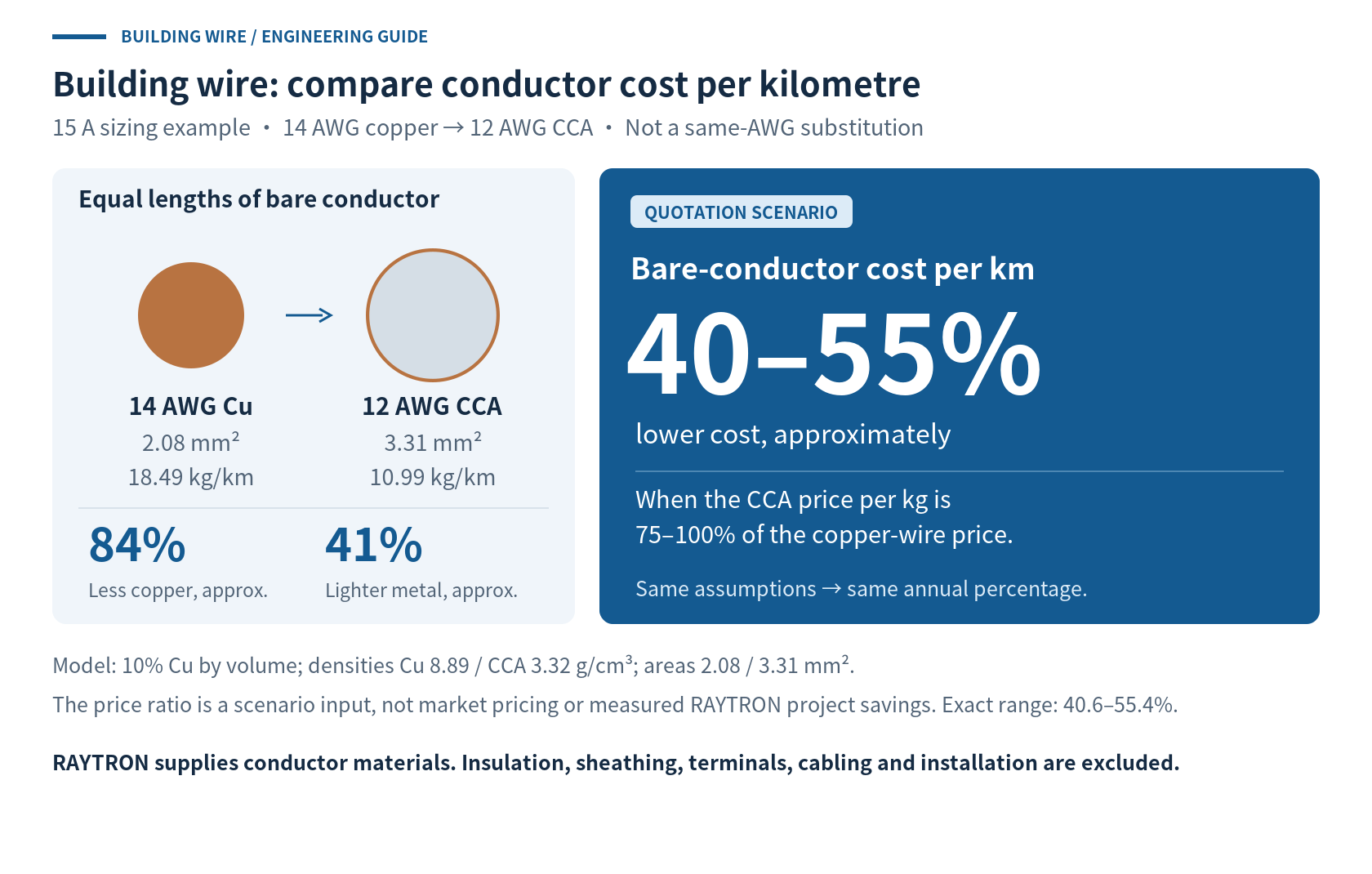
1. Why a larger conductor can still cost less per metre
The key is mass per unit length. The aluminum core provides most of the metal cross section, while the copper exterior provides the contact surface. Both metals carry current. Lower composite density creates room to adjust the conductor area while retaining a purchasing advantage.
| One conductor, equal 1,000 m length | 14 AWG copper | 12 AWG CCA |
|---|---|---|
| Calculation area | 2.08 mm² | 3.31 mm² |
| Calculation density | 8.89 g/cm³ | 3.32 g/cm³ |
| Conductor mass | 18.491 kg | 10.989 kg |
| Copper contained | 18.491 kg | 2.943 kg |
Here, CCA area increases by approximately 59.1%, yet conductor mass falls by 40.6% and copper consumption by 84.1%. Even equal prices per kilogram produce a substantial cost-per-kilometre difference.
Conductor mass (kg/km) = area (mm²) × density (g/cm³)
Purchasing cost per km = conductor mass × finished bare-wire price/kg
With q = CCA price/kg ÷ copper bare-wire price/kg, the model gives:
Purchasing reduction = 1 − 0.5942935 × q
| CCA price/kg relative to copper | Copper cost index | CCA cost index | Conductor purchasing reduction per km |
|---|---|---|---|
| 75% | 100 | 44.6 | 55.4% |
| 85% | 100 | 50.5 | 49.5% |
| 100% | 100 | 59.4 | 40.6% |
| 125% | 100 | 74.3 | 25.7% |
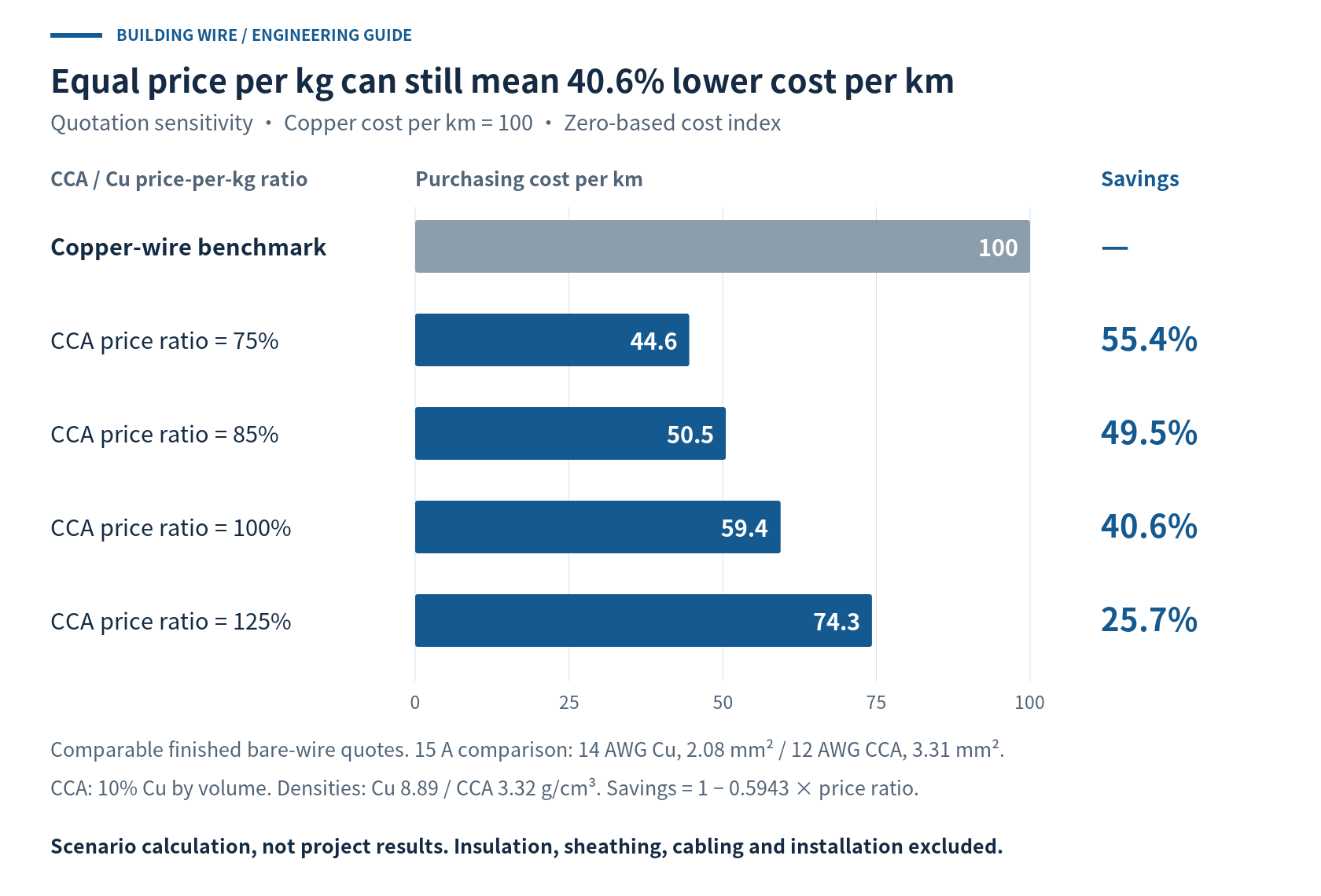
Put price/kg, kg/km and cost/km on the same purchasing sheet. Match delivery diameter, temper, freight, tax and packaging. Add downstream drawing cost and actual material utilization when moving from the material comparison to the production budget.
For one million conductor-metres annually, the model reduces metal purchases from 18.49 to 10.99 tonnes and copper consumption from 18.49 to 2.94 tonnes. At the 85% price ratio, annual conductor spend is approximately 49.5% lower. More volume increases the amount saved; the percentage stays constant for the same purchasing mix. Calculate each conductor in a multicore cable at its own size and accumulated length.
2. An established U.S. product pathway
CCA is already used in commercially documented U.S. NM-B and MC cables, with published sizes, constructions and certification information. The manufacturer's task is to implement that product pathway through its own conductor specification, insulation construction and production system.2, 3
Common starting comparisons for ordinary branch circuits include:
| Circuit comparison | Copper starting size | CCA starting size |
|---|---|---|
| 15 A | 14 AWG | 12 AWG |
| 20 A | 12 AWG | 10 AWG |
| 30 A | 10 AWG | 8 AWG |
Use the table to begin selection. Determine final size using the adopted NEC edition, cable type, overcurrent protection, terminal temperature rating, load and installation conditions. Check voltage drop for the actual run length.2, 4
Organize finished-product development by type: UL 83 addresses thermoplastic-insulated wire, UL 44 thermoset-insulated wire, and NM-B and MC follow their applicable UL 719 and UL 1569 product routes. RAYTRON supports the conductor material and specification; the cable manufacturer completes insulation, assembly and finished-product certification.3, 4, 8, 9
Connection options also have product-specific support. Schneider Electric identifies CCA suitability for the relevant Al/Cu or Cu/Al terminals on its U.S. QO/HOM breakers. Check the selected model, size, solid/stranded construction and installation instructions. Copper cladding alone does not qualify every copper-only splicing connector.11, 12
3. What RAYTRON brings to the conductor specification
RAYTRON's published U.S. building-wire development case addresses these customer requirements:1
| Customer requirement | Development focus |
|---|---|
| 10 AWG and 12 AWG; nominal diameters 2.588 and 2.053 mm | Delivered dimensions, roundness and downstream processing allowance |
| AA-8000 series alloy core and oxygen-free copper exterior | Material selection and lot identification |
| At least 10% copper by volume | Copper fraction, circumferential distribution and local minimum thickness |
| Tensile strength ≤138 MPa and elongation ≥15% | Drawing and annealing condition |
| Resistance and bond integrity after bending and twisting | Connecting material inspection to downstream processing |
These are customer requirements from the development program. Agreed supply limits are established through selection and sample approval.
The practical advantage is a coordinated specification: electrical properties, mechanical condition and cladding integrity are designed together. Purchasing, production and incoming inspection can work from the same requirements rather than a quotation containing only “CCA” and a diameter.
Cladding control: specify the average and the local minimum
Ten percent copper by volume describes the copper share of the metal cross section. For an ideal concentric round conductor:
t / D = [1 − √(1 − f)] / 2
At f = 10% and D = 2.053 mm, uniform radial copper thickness is approximately 52.7 μm. Specify the copper-fraction floor, local minimum thickness and eccentricity together to make both overall construction and local continuity inspectable.
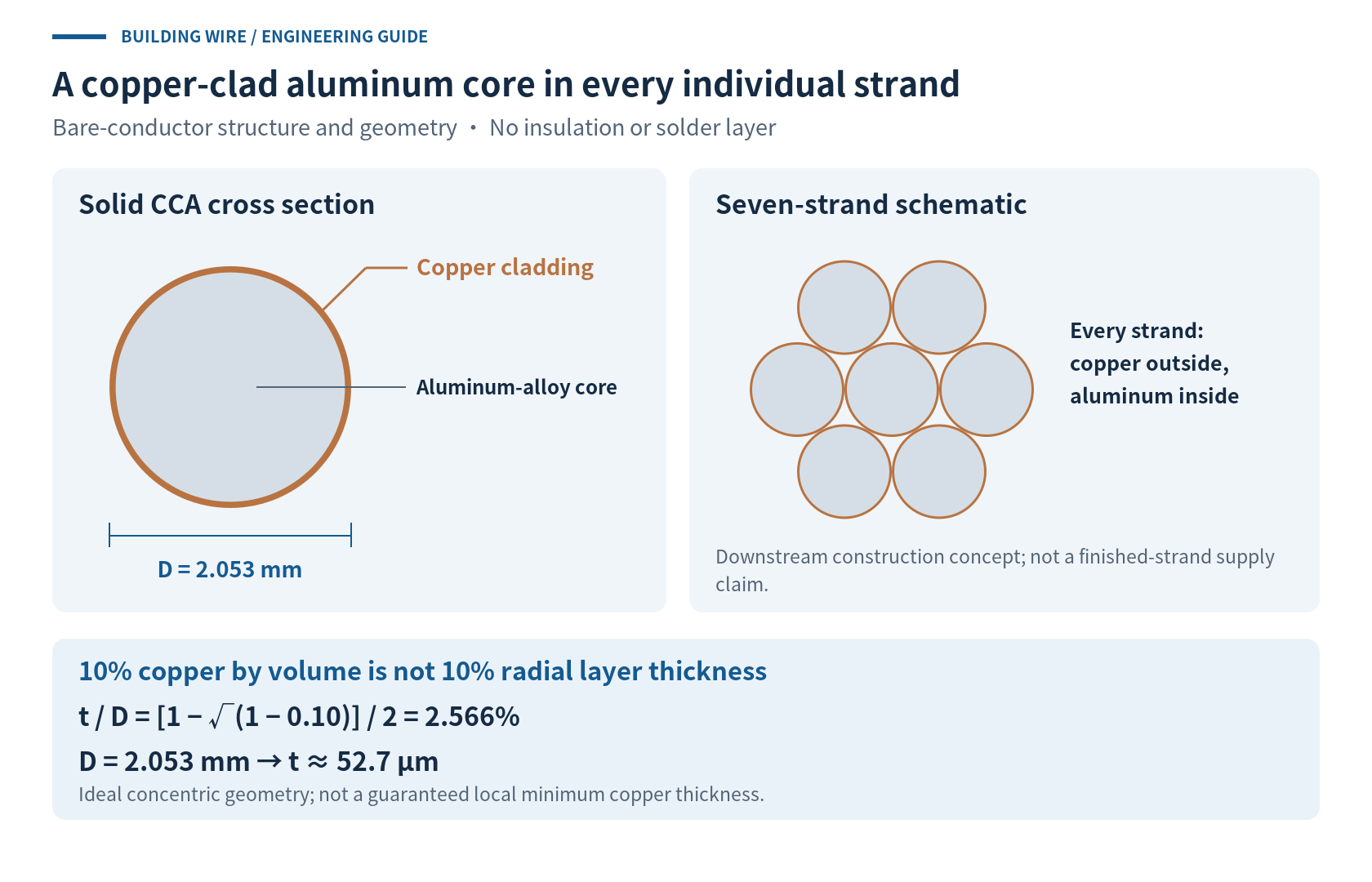
Schematic geometry. The 52.7 μm value is calculated for a uniform concentric layer; the stranded view illustrates a downstream cable construction.
Resistance control: define the final gauge
At building-wire frequencies, copper and aluminum both conduct current. Use resistivity at 20°C or Ω/km at the final gauge, and include the customer's subsequent drawing, annealing and stranding in confirmation. This keeps the quotation and the conductor entering cable production on the same basis.
Processing control: match material condition to the line
Core alloy, annealing condition, strength, elongation and bond integrity influence payout, drawing, bending and joining. AA-8000, CCA, CCAA and RAYTRON's HTCCA nomenclature describe different aspects of the material. The purchase specification resolves them into core composition, copper fraction, resistance and mechanical condition.
ASTM B566-04a(2025) provides nominal 10%/15% copper-volume classes and annealed/hard-drawn conditions for bare round CCA, supporting a defined material and inspection specification.7
4. Make the first discussion useful to purchasing
Send a copper-wire specification, target cable type or construction drawing. Include resistance requirements and forecast demand where available; the remaining sample details can be developed in the technical discussion.
| Discuss with RAYTRON | Purchasing decision it supports |
|---|---|
| Candidate CCA specification: core, copper fraction, diameter, resistance and supplied condition | Which option should enter a sample trial? |
| Cost-per-kilometre comparison: mass, comparable quotations and annual consumption | What is the conductor purchasing opportunity? |
| Line-trial priorities: dimensions, cladding, resistance and mechanical condition after processing | What evidence is needed to select the material? |
Establish the cost-per-kilometre opportunity, then confirm the specification with samples.
5. Turn the trial into a purchasing specification
Connect material, line and finished-product work through clear outputs:
| Stage | Main work | Output |
|---|---|---|
| Material confirmation | Core, cladding distribution, dimensions, resistance and mechanical condition | Sample specification and acceptance baseline |
| Customer line trial | Actual payout, drawing or stranding; inspect the processed conductor | Suitable supply condition and production parameters |
| Finished cable and connection | Applicable electrical, thermal, mechanical and certification evaluation | Confirmed material–cable–connection combination |
The production purchase specification then fixes diameter and tolerances, resistance limit, cladding requirements, mechanical condition, spool format, joint agreement and batch records. Changes in finished-cable diameter, insulation usage or connectors enter the complete manufacturing-cost assessment.
RAYTRON supplies the bare conductor. Defining that input early gives insulation, cable assembly and certification a consistent material basis.
Frequently asked questions
Which purchasing metric matters most for CCA building wire?
Cost per kilometre of conductor. Compare conductor size, density, mass per metre and finished bare-wire price together. In the stated example, equal prices per kilogram still produce a 40.6% lower cost per kilometre for 12 AWG CCA versus 14 AWG copper.
How can I apply the 40–55% scenario to my project?
Use the same method—mass per unit length multiplied by price/kg—with your copper baseline, candidate CCA and comparable quotations. The published range uses a 75–100% price ratio. Include actual consumption and process yield in the project budget.
How should the copper gauge change?
Match the circuit duty. Common comparisons begin with 14 AWG copper/12 AWG CCA for 15 A and 12 AWG copper/10 AWG CCA for 20 A. Final sizing follows the finished-product and installation requirements.2, 4
Must every connector be replaced?
Review existing hardware for the specific CCA material, size and conductor construction. Suitable devices can form part of the selected system; other positions need a matching model. Published guidance is available for CCA terminals on U.S. QO/HOM breakers.11, 12
Do I need complete technical documentation to request samples?
Start with a specification or drawing, target market and cable type. Include the resistance limit, quantity and spool information already available. RAYTRON can then discuss the remaining sample requirements with you.
What does RAYTRON supply?
CCA conductor materials, conductor wire and specification-development support. The cable manufacturer uses those inputs for insulation, cable assembly and the applicable finished-product certification.
Start with your current copper-wire specification
Use one specification sheet to discuss the CCA option, cost per kilometre and next sample step.
Compare my building-wire conductor with RAYTRON · View the U.S. development case · Explore CCA conductors
RAYTRON — Engineering Every Micron.
Sources and calculation basis
Cost percentages, mass and layer thickness are calculated from the inputs stated in this guide. References support industry product routes, standard scopes and project requirements.
Company project: RAYTRON building-wire development case.
Industry products: CCA NM-B specifications and CCA MC product pathway.
Standards and connections: UL cable guide, ASTM B566, UL 83, UL 44, UL termination guidance and Schneider terminal guidance.