
Flat Wire
Flat Wire for Coils and Electrical Parts
View specificationsRequest a quote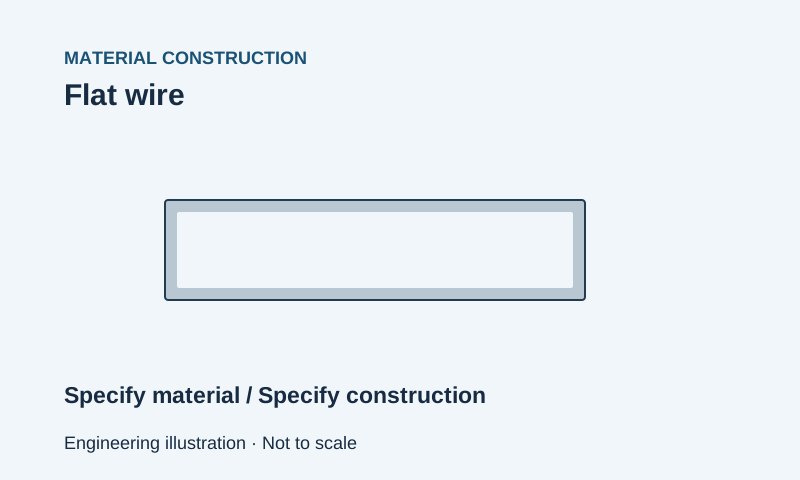
Flat wire provides a rectangular conductor section for coils and compact electrical parts. Compare copper, aluminum and clad options by finished resistance, weight, forming and connections. Specify width, thickness, corner radius and surface condition for the part or winding.
On this page
Construction and specification
Scroll horizontally to read all columns.
| Item | Specification |
|---|---|
| Material construction | Custom metal conductor construction |
| Product form | Flat wire |
| Surface | Bare, plated, annealed, insulated-ready |
| Supply format | Coils, spools or cut lengths |
Choose a material route
The drawing pairs width and thickness, corner geometry and material condition. Bare metal and a finished insulated envelope are separate specifications.
Insulated bimetal flat-wire engineering inquiriesSpecification design factors
Drawing-defined specification
Geometry and performance
- Width, thickness and corner shape define the conductor envelope.
- Camber, twist and bend direction affect winding and automated feeding.
- The metal section and any insulation build occupy separate parts of the finished envelope.
Selection and processing
Flat and rectangular wire describe the section; ribbon wire generally denotes a thin, narrow flat section. Compare material choices at the required resistance, winding space and joint design. The drawing defines the aspect ratio and corners rather than a universal maximum ratio.
Material and form references
Rolled strip, foil and flat wire are defined by material, temper, section and finished-part requirements. Their geometry and test methods differ from those of round wire.
Standards and product formsProduct questions
What is flat wire?
flat wire is a rectangular or ribbon-shaped conductor made by precision rolling or drawing, used where space utilization, heat dissipation and winding efficiency are important.
Why use flat wire instead of round wire?
Flat wire can improve slot fill factor, contact area, thermal path and packing density compared with round wire in motors, coils, transformers and power components.
Which drawing details are needed for Flat Wire for Coils and Electrical Parts?
Width, thickness and tolerances. Corner radius, edge condition, camber and twist. Metal grade and temper. Surface finish or coating, joining method and inspection requirements. Quantity, spool or coil format, packaging and delivery destination.
How does a flat section behave in bending and winding?
Width, thickness and corner geometry define the conductor envelope. Bending about the long and short edges produces different strains and springback. Bare metal and insulated finished dimensions occupy different portions of the available winding space.
Related products
Prepare your inquiry
- Width, thickness and tolerances
- Corner radius, edge condition, camber and twist
- Metal grade and temper
- Surface finish or coating, joining method and inspection requirements
- Quantity, spool or coil format, packaging and delivery destination