
LV Concentric Neutral & Service Cables
CCA wire selection around resistance targets, cable construction and utility references.
Explore LV Concentric Neutral & Service CablesCopper Clad Aluminum Conductors
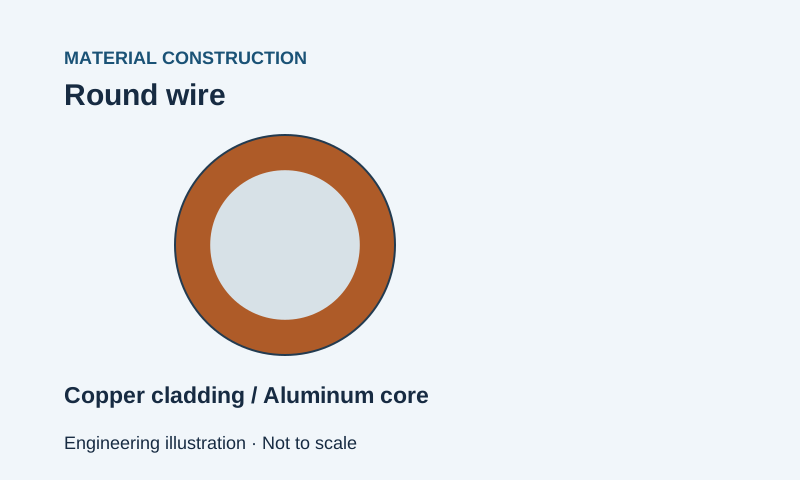
Copper-clad aluminum round wire combines a copper surface with a lightweight aluminum core. It serves cable designs whose governing standards permit CCA, with the conductor role, section and connection matched to the electrical duty.
Scroll horizontally to read all columns.
| Item | Specification |
|---|---|
| Material construction | Aluminum core with copper cladding; copper proportion is expressed on a mass or volume basis |
| Product form | Round wire |
Drawing-defined specification
A coaxial center conductor carries a high-frequency signal; a low-voltage concentric neutral carries its designed neutral current; a medium-voltage metallic screen carries the specified screen and fault duty. These roles use different resistance, mechanical and connection criteria.
The copper surface and aluminum core share the conductor section. Copper proportion, diameter and temper influence resistance, mass and forming behavior. Mass percentage and volume percentage express different ratios.
Where an Ethernet or PoE cable specification requires copper, CCA is not a default substitute. Passing signal tests cannot establish permission to use a different conductor material.
Design reference for low-voltage DC track conductors only — not an approved mass substitution.
Fixed-condition engineering models for AWG 6–30; not certified current ratings or direct substitution approval.
ASTM B566-04a(2025) covers bare round copper-clad aluminum wire, with classes and requirements for the single-wire construction.
Standards and product formsMetal construction, diameter and temper define the conductor section. Resistance varies with length and temperature. Surface condition, coating and any insulation affect joining and the finished assembly diameter.
No. Copper proportion describes a mass, volume or area basis. Conductivity describes electrical behavior under stated measurement conditions. The supplied construction identifies both, together with section, material condition and resistance.
Bare diameter and ovality describe the metal section. Coating or insulation adds to the finished diameter. Keep the electrical measurement length and temperature with the resistance value for that construction.
CCA wire selection around resistance targets, cable construction and utility references.
Explore LV Concentric Neutral & Service CablesCompare screen resistance, fault duty, geometry and connection requirements.
Explore MV Metallic Screen Wire