
Engineering application guide
High-Frequency Transformer Foil Windings
Start with the transformer winding space, waveform and thermal duty. Copper, aluminum and copper-clad aluminum (CCA) foil need different conductor sections and joining provisions; compare them on the same design basis.
Discuss the assembly requirementsOn this page
Foil within the winding stack
- 1Foil conductor turn
- 2Interlayer insulation
- 3Next turn and terminal exit
Foil thickness and width describe the metal, while insulation and turn arrangement define the stack. The terminal exit is part of the electrical and thermal path.
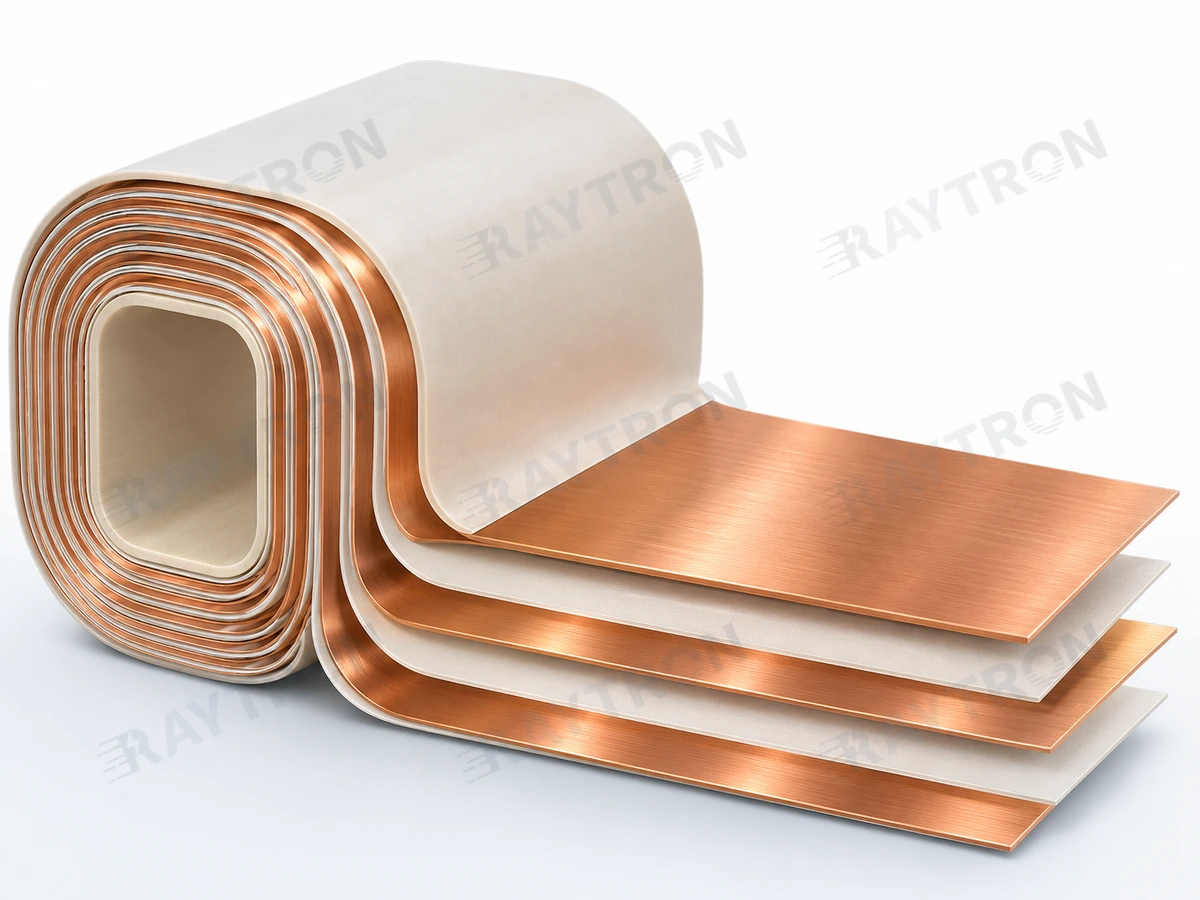
Distinguish DC resistance from frequency-dependent winding loss. Compare candidates with the same waveform, winding geometry and cooling conditions; use calculation or measurement sources for any loss curve.
Related conductor products
Design and testing
- Foil and winding geometry
- Specify metal grade or layer construction, thickness, width, tolerances, edge burr limits, insulation and winding arrangement.
- Loss and thermal conditions
- Provide switching frequency and waveform, current, turn count, cooling and allowable temperature rise. Compare DC resistance and AC loss on the same design basis.
- Joints and inspection
- Define terminal materials and joining method, joint resistance, mechanical tests, insulation acceptance and packaging. Evaluate the selected foil with the intended winding process.
Application design factors
Compare winding losses at the same frequency, waveform, temperature and geometry. Bare metal and a finished insulated winding are separate supply items.
Application design record — open worksheet
Record your project requirements and observations, then download or include them in an inquiry.
| Item | Information / units | Your input |
|---|---|---|
| Common electrical basis | Frequency spectrum, waveform, RMS/peak current, duty and temperature | |
| Winding geometry | Turns, usable width/thickness, winding length, insulation gaps, edge condition and joining | |
| Loss and temperature record | DC/AC resistance or loss method, winding/core separation, temperature rise, specimen and acceptance source |
Other formats and preview
Save or restore a draft
Drafts stay in this browser. Clear inputs also removes the saved draft.
Worksheet version: RT-RFQ-WORKSHEET-1.
How should copper, aluminum and CCA foils be compared?
Use the same winding duty, frequency, waveform and temperature. Evaluate metallic section, winding length, DC and AC loss, heat removal, insulation and joints in the actual transformer.