
Nickel Clad Copper Conductors
Nickel-Clad Copper Strip
View specificationsRequest a quote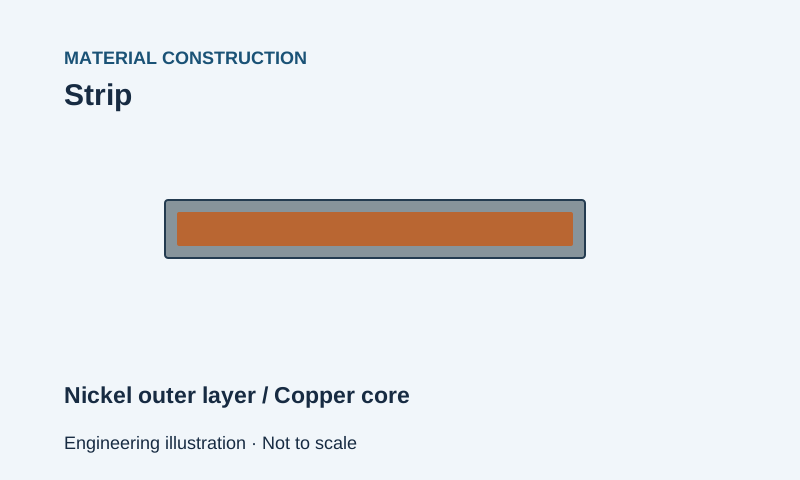
NCC strip combines a copper core with nickel cladding for conductive parts that need a nickel joining or contact surface. For battery and other electrical connections, specify strip dimensions, layer construction and the mating materials, then define the welding and operating requirements.
On this page
Construction and specification
Scroll horizontally to read all columns.
| Item | Specification |
|---|---|
| Material construction | Copper core with a nickel outer layer |
| Product form | Strip |
| Nickel layer | Custom layer ratio by corrosion, welding and temperature requirement |
| Application environment | Battery, high temperature, corrosive, hydrogen or sensor applications |
Explore the related product details for this material and product form.
Specification design factors
Drawing-defined specification
Geometry and performance
- Thickness, width and temper govern forming and stamping behavior.
- Edge profile, burr direction and rolling direction affect the finished part.
- Surface and joining conditions determine electrical contact at the connection.
Selection and processing
Compare the nickel surface requirement separately from the copper conductive section. Include mating metals, weld design, exposed edges and service medium. Nickel-clad and nickel-plated copper need their actual layer construction and process specified; the names alone do not establish interchangeability.
Material and form references
Rolled strip, foil and flat wire are defined by material, temper, section and finished-part requirements. Their geometry and test methods differ from those of round wire.
Standards and product formsProduct questions
What affects strip forming and coil handling?
Thickness, width, temper and rolling direction govern forming response. Edge profile and burr direction affect the finished part. Camber describes lateral curvature; flatness describes departure from a plane, so the two address different processing effects.
What defines the nickel surface at the connection?
The layer construction, thickness by face or stated proportion, surface condition and any exposed cut edge describe the contact surface. Mating material, joint geometry and joining process define the connection test.
How are width and thickness related to the finished part?
The drawing pairs width and thickness and identifies corners, edge condition and temper. Separate width and thickness limits do not establish every combination. A coating or insulation build is recorded separately from the bare metal section.
Related products
Prepare your inquiry
- Width, thickness and tolerances
- Edge condition, burr, surface and roll dimensions
- Core and outer-layer metals, each layer or ratio, and mass or volume basis
- Surface finish or coating, joining method and inspection requirements
- Quantity, spool or coil format, packaging and delivery destination