
Nickel Clad Copper Conductors
Nickel-Clad Copper Round Wire
View specificationsRequest a quote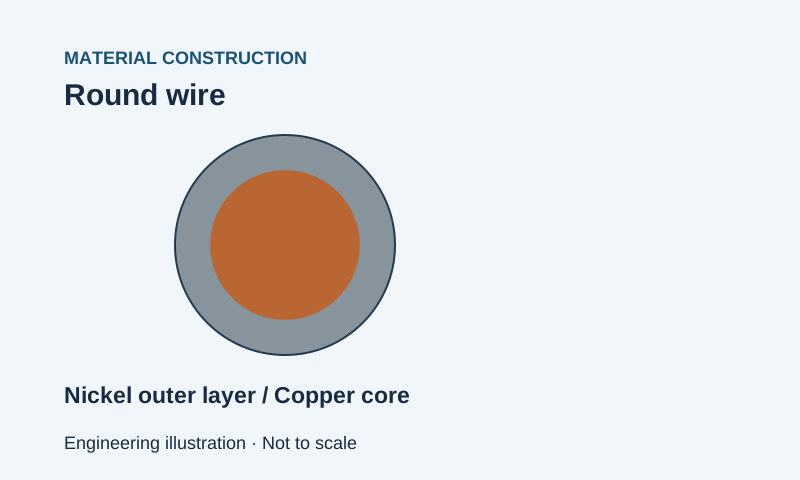
NCC round wire has a copper core with nickel cladding. Select the construction around the required resistance, joining method and service environment. For elevated-temperature use, include the temperature profile, exposure time and insulation system in the specification.
On this page
Construction and specification
Scroll horizontally to read all columns.
| Item | Specification |
|---|---|
| Material construction | Copper core with a nickel outer layer |
| Product form | Round wire |
| Nickel layer | Custom layer ratio by corrosion, welding and temperature requirement |
| Application environment | Battery, high temperature, corrosive, hydrogen or sensor applications |
Explore the related product details for this material and product form.
Specification design factors
Drawing-defined specification
Geometry and performance
- Diameter and ovality determine the metal section and fit in the finished assembly.
- Resistance depends on material, section, length and temperature.
- Temper and surface condition affect drawing, bending and joining.
Selection and processing
There is no construction-independent operating-temperature rating. The conductor, surface, insulation, joint and exposure time set different limits. Define the thermal profile and required electrical/mechanical checks for the finished lead or connection.
Material and form references
ASTM B355-11(2024) concerns nickel-coated soft or annealed round copper wire. Its construction and nickel mass classes apply to that defined round-wire product.
Standards and product formsProduct questions
What determines a round conductor’s electrical and forming behavior?
Metal construction, diameter and temper define the conductor section. Resistance varies with length and temperature. Surface condition, coating and any insulation affect joining and the finished assembly diameter.
What defines the nickel surface at the connection?
The layer construction, thickness by face or stated proportion, surface condition and any exposed cut edge describe the contact surface. Mating material, joint geometry and joining process define the connection test.
Which diameter belongs in the conductor specification?
Bare diameter and ovality describe the metal section. Coating or insulation adds to the finished diameter. Keep the electrical measurement length and temperature with the resistance value for that construction.
Related products
Prepare your inquiry
- Bare conductor diameter, tolerance and finished diameter if coated or insulated
- Temper, required resistance and termination
- Core and outer-layer metals, each layer or ratio, and mass or volume basis
- Surface finish or coating, joining method and inspection requirements
- Quantity, spool or coil format, packaging and delivery destination