
Copper Clad Steel Conductors
Copper-Clad Steel Stranded Wire
View specificationsRequest a quote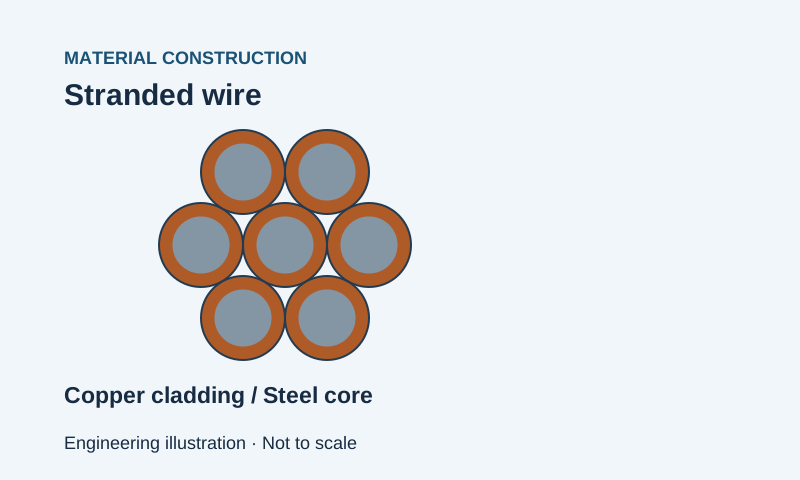
CCS stranded conductors combine copper-clad steel wires in a defined strand construction. Specify strand count, individual wire size, overall diameter and lay, together with the tensile and resistance requirements. Include connection and corrosion conditions for grounding work.
On this page
Construction and specification
Scroll horizontally to read all columns.
| Item | Specification |
|---|---|
| Material construction | Steel core with a copper outer layer |
| Product form | Stranded wire |
| Strength target | Specified by tensile strength, steel core and application load |
| Use environment | Grounding, cable, rail, connector or high-vibration signal use |
Explore the related product details for this material and product form.
Specification design factors
Drawing-defined specification
Geometry and performance
- Wire count, single-wire diameter and lay define the complete strand.
- Finished-strand resistance and breaking load describe the assembled conductor.
- Layer arrangement, bending and terminal geometry determine handling and connection performance.
Selection and processing
Single-wire tensile or resistance data do not describe the complete strand by themselves. Set strand count, wire diameter, lay and finished section, then define how the assembly resistance, tensile load and terminations are tested.
Material and form references
Finished stranded-conductor performance combines single-wire material properties with strand count, diameter, lay and connections. Resistance and breaking load describe the complete strand; the finished cable also has its own construction and application requirements.
Standards and product formsProduct questions
What determines the behavior of the finished strand?
Wire count, single-wire diameter, layer arrangement and lay define the metallic area and flexibility. Resistance and breaking load describe the complete strand, while the termination connects that strand to the cable or installation.
Are single-wire strength and complete-strand breaking load the same specification?
No. Single-wire material properties and finished-conductor breaking load describe different specimens. Wire diameter, count, lay and connections define the assembled strand and its test record.
How are individual wires and finished-strand dimensions specified?
The construction identifies wire count, individual diameter, lay direction and finished outside diameter separately. Metallic area is the metal in the wires; spaces between wires are part of the strand envelope.
Related products
Prepare your inquiry
- Strand count, strand diameter, lay and finished diameter
- Required resistance, tensile load and termination
- Core and outer-layer metals, each layer or ratio, and mass or volume basis
- Surface finish or coating, joining method and inspection requirements
- Quantity, spool or coil format, packaging and delivery destination